
Pages from history
Laocoön
In
Greek mythology Laocoön is the Trojan priest of the god Apollo at the time of
the Trojan War. Towards the end of this war Apollo sends two gigantic  snakes
from the sea to strangle Laocoön: an ominous portent of the fall of Troy.
snakes
from the sea to strangle Laocoön: an ominous portent of the fall of Troy.
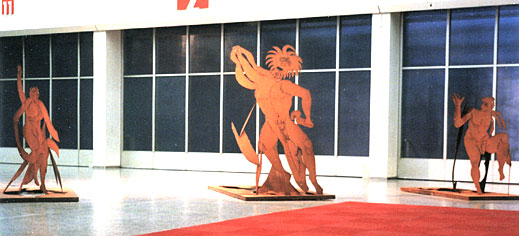
In Pages from
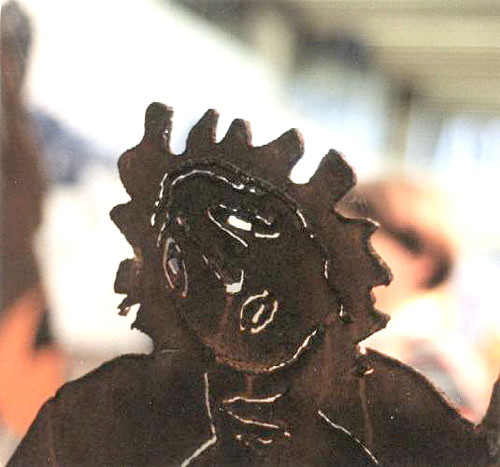
History the figures of the father and his sons rise from the (steel) 'pages' on
the floor. Their contours are left behind as a reference to the origin of (the)
myth: every historical period weaves its own fables starting from the beginning.
The archaic period at the dawn of our civilisation in which the Trojan War took place
can be seen as a period of original force from which we
are drifting away. The father figure symbolises the power and strength of this
original vigour. The figures of his sons refer to our losing contact with the
pure energy of our beginnings. Theylook helpless, weak and degenerate. The serpents
symbolise the attack of nihilism on our civilisation: a hidden and faceless process
which surreptitiously gnaws at the roots of our culture. As a sign of the invisibility
of this hidden monster the snails are hardly to be seen in the composition.
As a sign of the invisibility
of this hidden monster the snails are hardly to be seen in the composition.)
In Greek mythology the story of Troy is a tale of death and destruction.
Particularly gruesome is the fate of the priest Laocoön and his two sons. According
to the legend they were crushed by giant snakes emerging from the sea.
In Greek prehistoric times Troy (Ilium, Ilion) was a town in a coastal plain in
Asia Minor. The story of the siege of Troy was told by the great epic poet Homer
(c.1200 BC) who probably lived in the eighth century before Christ. Its remnants,
discovered by Schliemann, now are situated in Turkey.
Homer's epic poem
the Iliad gives an account of the Trojan War which is unparalleled in epic rigour
and vigour. It tells a parallel story of human and superhuman destiny forged into
one plot by the inevitability of the causal chain of events. Underlying theme
of the narrative is the seduction of Helena, the most beautiful woman in Greece,
by Paris, son of Priam, the last king of Troy. Helena, daughter of the god Zeus
by Leda, was married to Menelaos, king of Sparta. Paris persuaded Helena to flee
to Troy with him. For this reason the Greek rulers assemble under Agamemnon and
lay siege to Troy. A siege which was to last for ten years. The Iliad starts at
some point during this long and protracted battle in the plain of Troy. Even the
family of gods gets involved; they start quarrelling and try to influence the
human chain of events, taking sides in the conflict of men. 
The god
Apollo, already angered by the behaviour of his priest Laocoön who did not remain
celibate, sends two giant snails from the sea to kill him after he had started
warning the Trojans not to let the wooden horse of the Greeks into town. The two
monsters even penetrate the temple of the goddess Athena in the Trojan fortress.
Bereft of the wisdom of their priest, the Trojans fall victim to their folly.
During the night the Greeks crawl out of the wooden horse and take Troy.

Website © Irène Prinsen, visitors of this site are reminded that the exhibited works and commentaries are subject to copyright law. For use of works of visual artists affiliated with a CISAC-organisation, other than consultation via Internet, permission is required from Pictoright, visuele auteursrechten Nederland.